Chair of Democracy 2026: Professor Miguel Poiares Maduro
Editing Democracy:
On the Causes of Democratic Disillusionment and the Search for Remedies
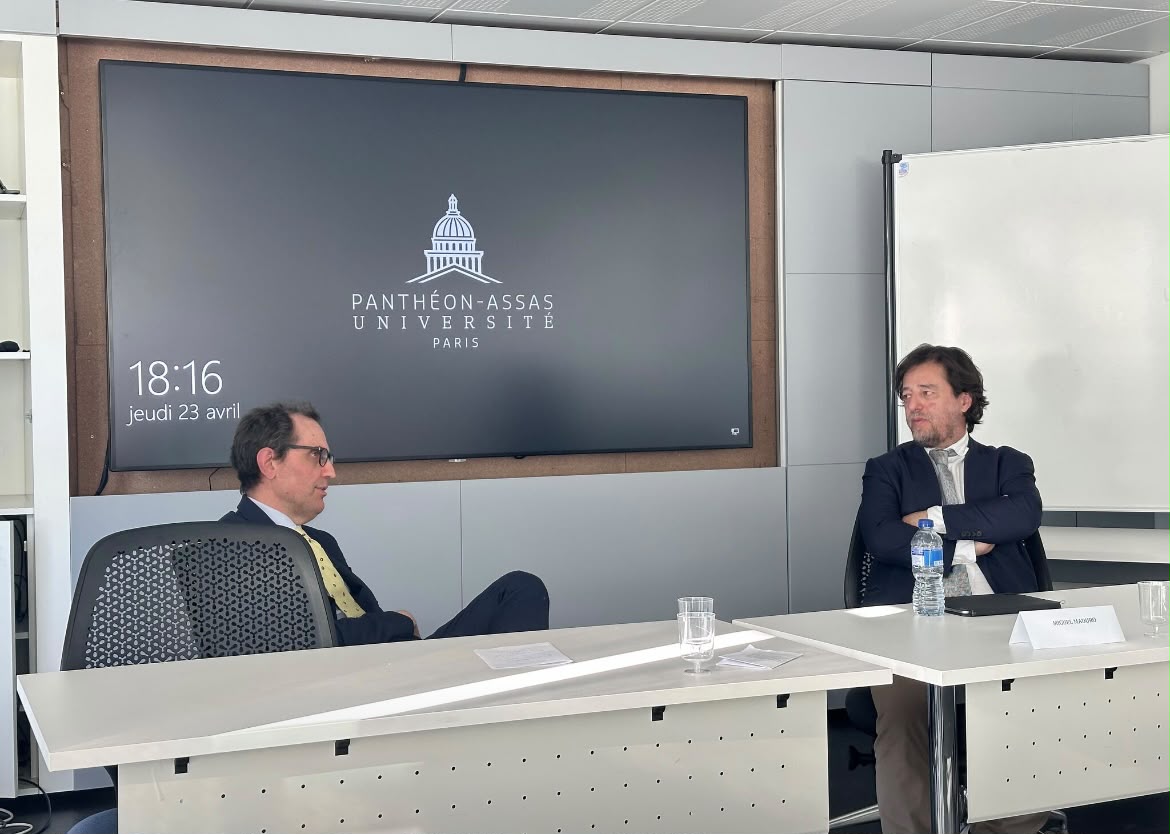
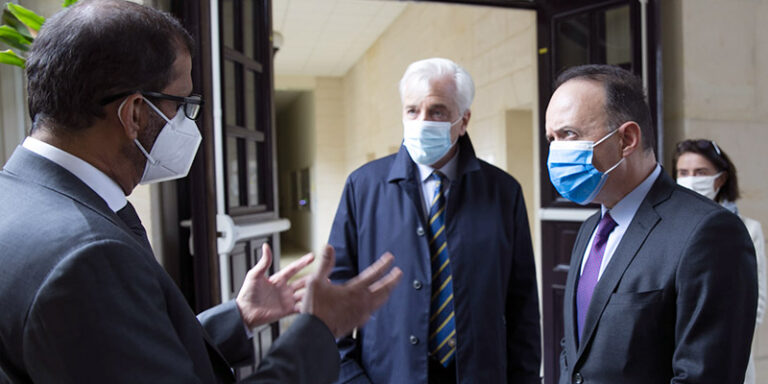
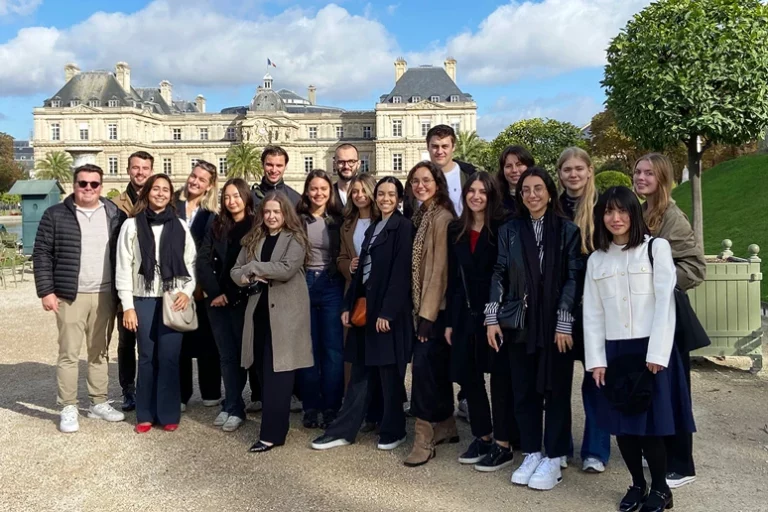
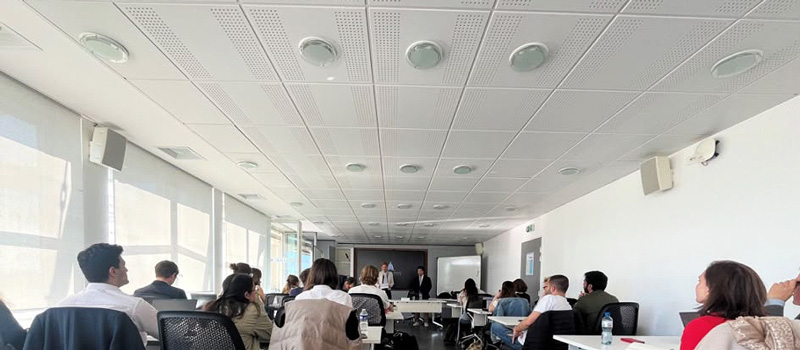
On 23 April 2026, the students of the LL.M. “Public Law and Democracy” and the Institut Michel Villey had the honor of welcoming Professor Miguel Poiares Maduro, holder of this year’s Chair of Democracy, to the Centre d’Assas for a seminar on “Editing Democracy”. During this lecture, the professor offered an in-depth analysis of the cognitive, epistemic and deliberative issues underlying current democratic disillusionment and backsliding. Beyond this diagnosis, the professor articulated several institutional responses to these problems – among them a particular unconventional deployment of EU competition law.
Professor Maduro opened his lecture by identifying a number of familiar and widely discussed symptoms of the fundamental problems underlying the contemporary democratic condition. Among the successive generations that came of age after the Second World War, the proportion of people who regard democratic government as fundamental to their way of life has declined from approximately 73% to 45%. Similarly, the recent rise of populist movements across Europe may be understood as evidence of a declining trust in the traditional democratic social compact. Parallel tendencies can be observed across different countries, thereby ruling out contextual narratives or country-specific explanations for the declining trust in democratic institutions.
Rather than relying on the prevailing surface-level explanations of these crises, Professor Maduro locates the source of these developments in a transformation of the democratic ecosystem, namely in the erosion of the nexus of democratic representation. There appears to be a growing distrust in the integrity of the representative process, resulting in increasing disillusionment with the tradition of representative democracy. For representative democracy to function, certain cognitive (formation and communication of political preferences), epistemic (agreeing on what constitutes a fact) and deliberative (the terms of disagreement) conditions have to be in place. These democratic conditions, however, do not arise spontaneously. Rather, they are shaped by institutional intermediaries engaged in the task of editing democracy, that is, of creating societal conditions conductive to democratic interaction and of rendering democratic representation possible. Such intermediaries include, inter alia, the traditional media, political parties, NGOs, unions, universities, experts, courts and independent agencies.
According to the professor, it is precisely this process of editing democracy that has undergone fundamental change in recent years, profoundly altering the societal conditions on which the proper functioning of representative democracy depends. First, increasing globalization and internationalization have created an inherently transnational political order to which traditional political entities, and in particular nation-states, have failed to adapt properly. Second, the rapid evolution of technology has profoundly accelerated social life in terms of the speed at which information can be produced and disseminated, the volume of information competing for our attention, the pace of communication and the number of people with whom we can communicate. Third, the arena of politics has shifted from a public sphere to a largely virtual space of political deliberation.
Consequently, the cognitive, epistemic and deliberative democratic conditions have also been substantially altered. For example, on a cognitive level, the accelerated pace of technologically mediated communication has weakened the deliberative dimension of thought, making way for a more emotionally driven cognitive process. In addition, new technologies have generated greater epistemic uncertainty, making it increasingly difficult for political opponents even to agree on basic facts. Furthermore, increased political polarization has made it impossible to agree on the so-called terms of disagreement, rendering the public arena into a civil war without weapons where adversaries are qualified as enemies instead of mere opponents. Given these changing conditions, Professor Maduro argues that it is no surprise that democratic disillusionment is at an all-time high.
Beyond this diagnosis, the professor also lays the groundwork for several possible solutions to these problems. A first solution lies in the understanding that current digital platforms act as if they are public entities and should therefore be treated as such. These digital platforms now effectively regulate the contemporary public arena and should therefore be held democratically accountable for their role in editing the democratic deliberative sphere. More troubling still is the fact that the increasing influence of these platforms tends to create a monopoly over the public arena. Whereas people used to be able to choose from a wide range of news outlets, the current deliberative sphere is increasingly channeled through a limited number of platforms governed by platform-based algorithms. According to Professor Maduro, one possible solution to this problem is a diversification of algorithms, allowing users to choose between different algorithms on a particular digital platform.
Given sufficient political will at the European level, the solutions outlined during the lecture could be realized through existing legal instruments. The Bosman-ruling of the ECJ may serve as a precedent for requiring digital platforms that exercise effective regulatory power to comply with EU law, whilst EU competition law and, more specifically, the prohibition of the abuse of a dominant position (Article 102 TFEU), could be used to promote a more pluralistic range of algorithms on digital platforms. It remains to be seen, however, whether these proposals will remain confined to theoretical academic debate or will instead be effectively implemented as part of a broader effort to restore the cognitive, epistemic and deliberative preconditions that underpin our contemporary democratic system.
Professor Maduro’s discourse was followed by a discussion in which the LL.M. candidates, the doctoral students of the Institut Michel Villey and several professors from Panthéon-Assas exchanged views on the solutions put forward during the lecture. The discussion addressed whether measures concerning editing democracy should be implemented at the national or the European level and whether these measures were feasible in the current geopolitical context.
The students of the LL.M. “Public Law and Democracy” thank the professor for his insightful lecture and eagerly await his forthcoming book on “Editing Democracy”.
Korneel Persoon, LL.M. Candidate “Public Law and Democracy” Pantheon-Assas-Université